

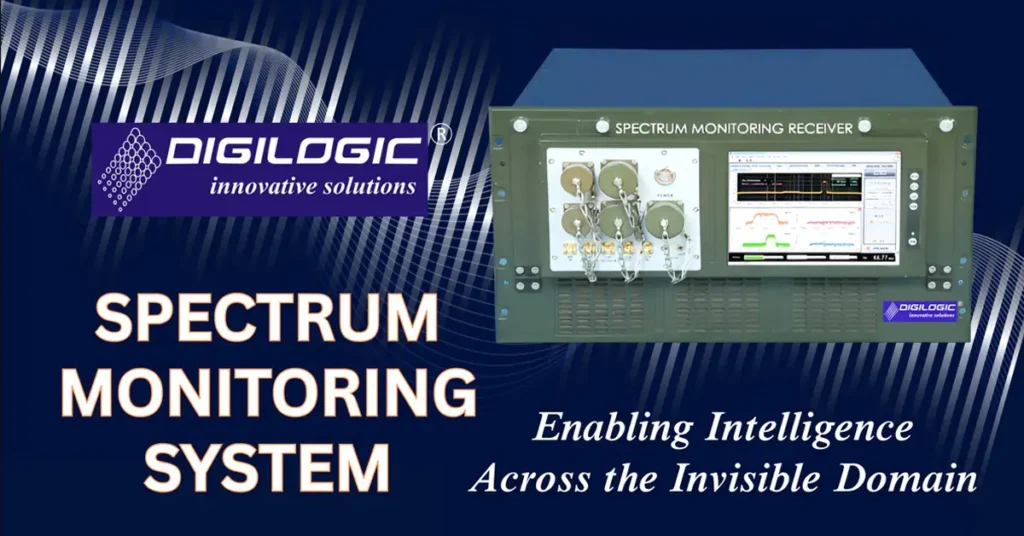
In an era where communication defines capability, the radio frequency (RF) spectrum has become one of the most contested and valuable domains. From tactical communications and radar to navigation, telemetry, and wireless control systems, everything depends on how effectively this invisible spectrum is managed and protected. For defence, aerospace, and industrial applications alike, spectrum monitoring has evolved from a compliance necessity to a strategic intelligence function enabling operational awareness, interference detection, and security assurance in real time.
Understanding the Spectrum Challenge
Modern RF environments are complex and dynamic. The exponential growth of wireless technologies, coupled with the increasing sophistication of electronic warfare (EW) and jamming systems, has led to crowded, unpredictable frequency bands. In such conditions, knowing what occupies the spectrum, where, and when becomes critical. Whether it is identifying unauthorized transmissions, locating interference sources, or validating signal integrity during mission operations, spectrum monitoring systems serve as the sensory unit of the electromagnetic domain.
Spectrum monitoring extends beyond identifying frequencies, it interprets the electromagnetic environment. By integrating intelligent algorithms, the system can automatically detect anomalies, compare spectral signatures against known patterns, and trigger alerts for unauthorized or hostile emissions.
Traditional spectrum analyzers offer static snapshots; however, today’s mission requirements demand continuous, wideband, and automated monitoring across multiple frequency ranges with high temporal resolution and accuracy.
The Architecture of a Modern Spectrum Monitoring System
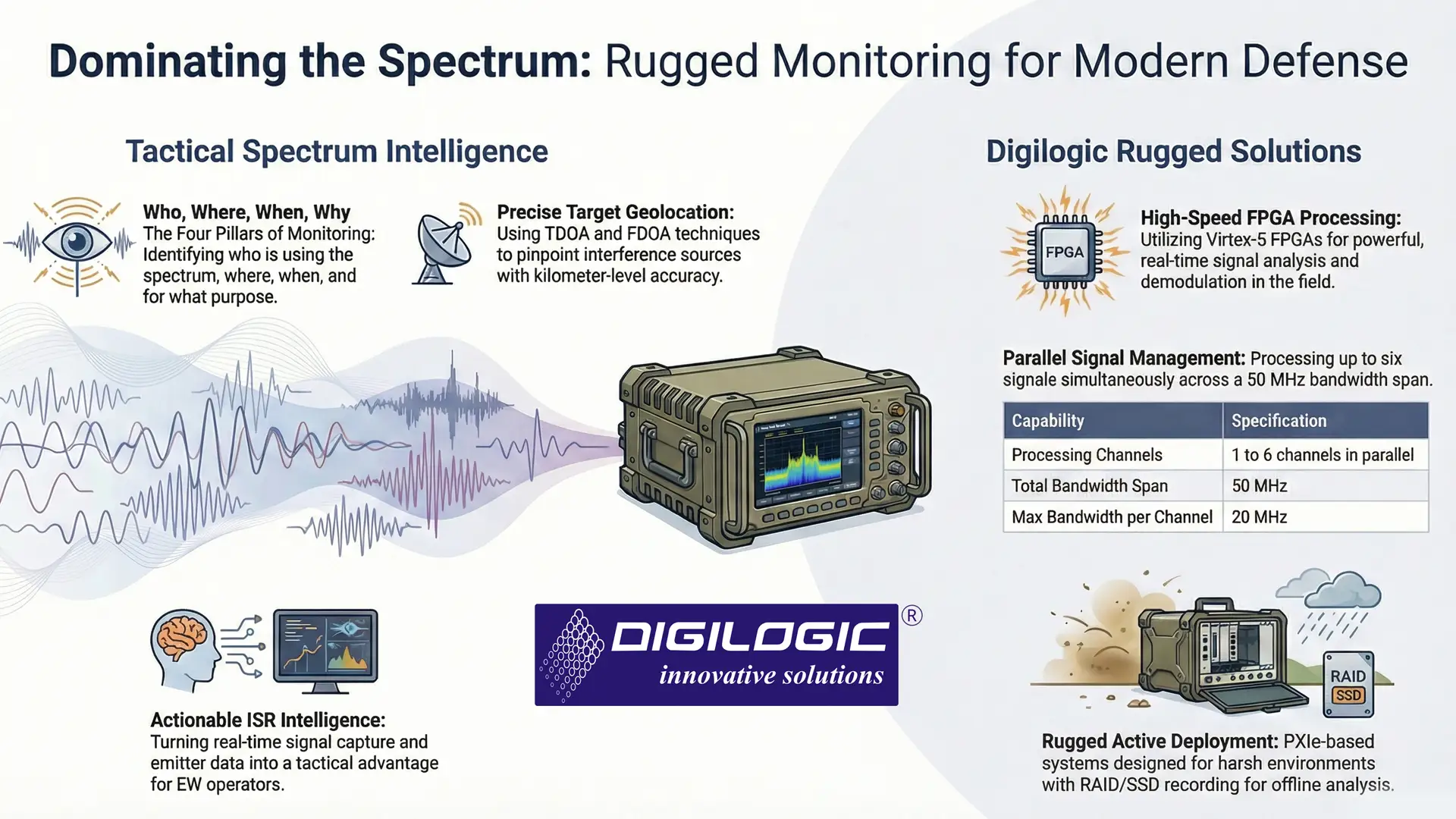
A spectrum monitoring solution blends high-performance hardware with intelligent software analytics, creating a complete chain from signal capture to actionable insight.
At its core, such a system typically comprises:
- Wideband RF Front Ends: Covering frequency ranges from a few kHz up to tens of GHz, optimized for sensitivity and precision.
- High-Speed Digitizers and Converters: Performing real-time sampling of wide bandwidths, often exceeding hundreds of MHz, ensuring no transient signal goes undetected.
- FPGA/SoC-Based Processing: Enables on-board FFT, power spectral density computation, and trigger-based capture for time-critical events.
- Advanced Signal Analysis Software: Offers live spectral visualization, waterfall displays, occupancy plots, and signal classification based on modulation patterns.
- Networking and Control Interfaces: Support remote operation, distributed monitoring, and centralized data aggregation through Ethernet or PXI backplanes.
Such architectures allow for real-time scanning, data recording, and automated analysis integral capabilities for applications where milliseconds can make a difference.
Engineering for Field and Lab
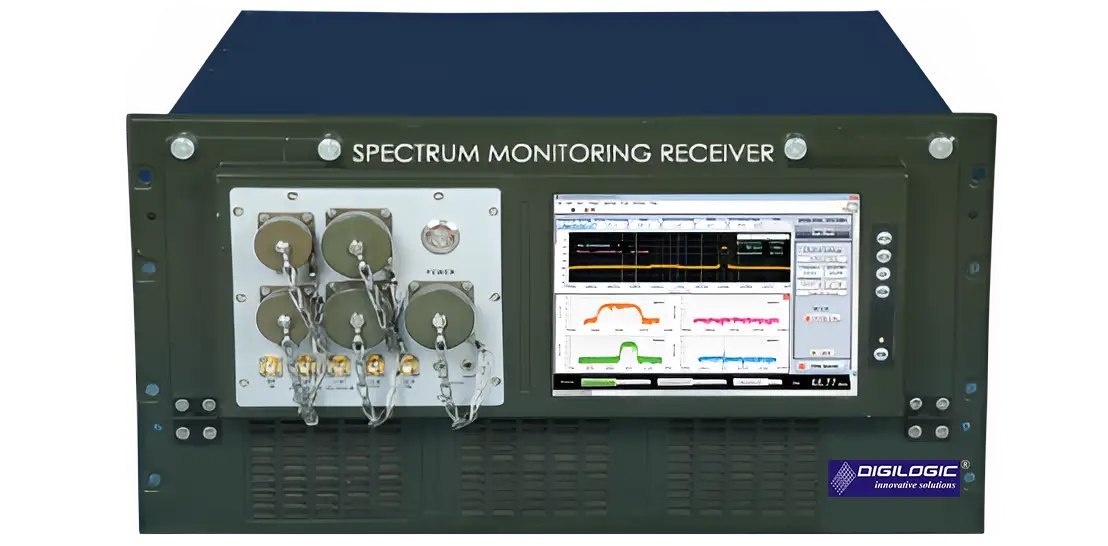
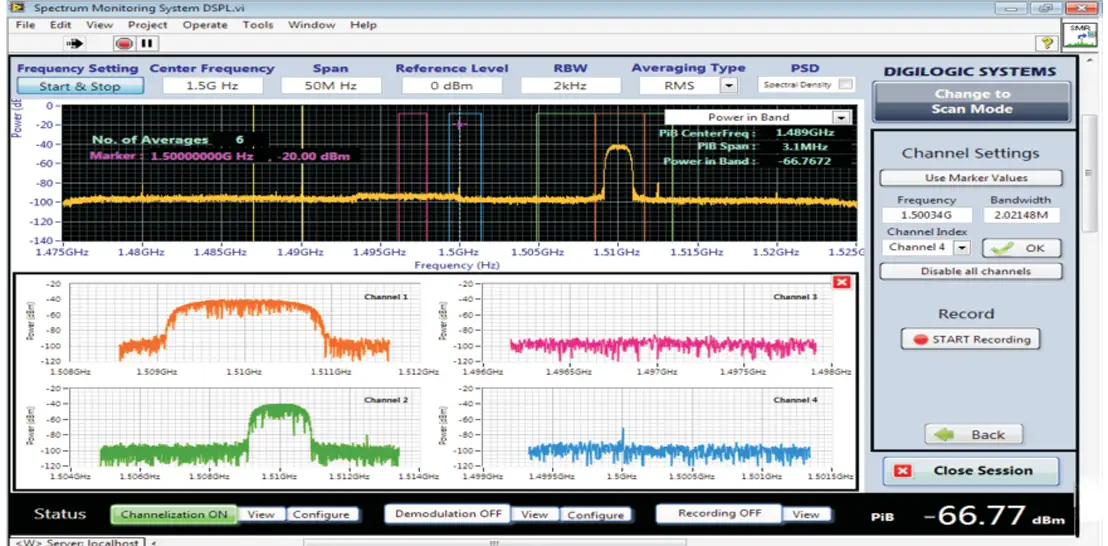
Spectrum monitoring systems must balance laboratory-grade precision with field-ready resilience. Digilogic Systems engineering approach emphasizes modular and scalable designs built on PXI or standalone platforms, offering flexibility to adapt across deployment contexts.
Wide dynamic range enabled RF front ends ensure the capture of both faint and high-power signals without distortion, while GPS-synchronized time-stamping aligns measurements across distributed sensors. Ruggedized enclosures and EMI-shielded assemblies enable deployment in harsh operational zones, while high-throughput data streaming ensures lossless capture for post-event analysis.
These systems are not just passive observers; they are active diagnostic tools, capable of recording, replaying, and correlating spectral data to reveal patterns invisible to regular systems.
Applications Across Domains
Spectrum monitoring technology finds applications across a spectrum of domains:
- Defence & Electronic Warfare: Detection of jammers, signal interception, and threat analysis.
- Aerospace & Avionics: Monitoring telemetry and communication links during test and evaluation phases.
- Telecommunication & Regulatory: Enforcement of spectrum licensing, interference detection, and compliance validation.
- Research & Development: Characterizing RF environments, validating new transmitters, and developing resilient communication architectures.
By offering visibility into the unseen, spectrum monitoring strengthens both security and performance, essential attributes in mission-critical systems.
Toward Intelligent Spectrum Awareness
As the RF domain grows denser and more contested, the next evolution lies in AI-enabled spectrum intelligence, systems that not only capture and display signals but also learn, classify, and predict. By integrating real-time analytics, machine learning, and data fusion with traditional monitoring hardware, organizations can achieve proactive spectrum management, anticipate threats and optimizing communication performance before issues arise.
At Digilogic Systems, this philosophy of engineering intelligence underpins every solution transforming complex data into clarity, enabling engineers to see beyond data, and ensuring reliability across every frequency that’s critical.
In a world defined by connectivity, the real power lies in what we can detect, decode, and defend. Spectrum monitoring makes that power measurable, manageable, and meaningful.