

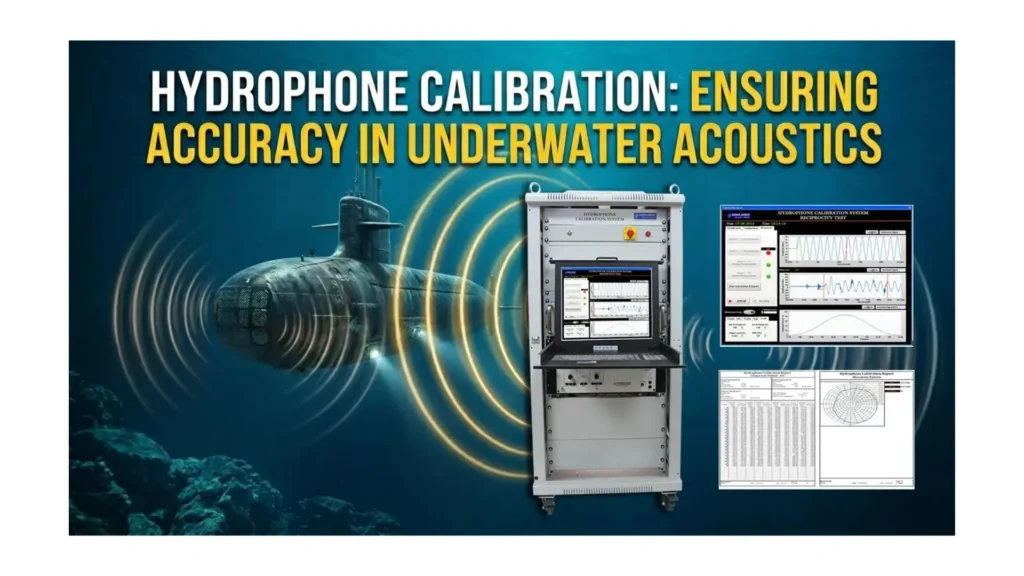
Underwater environments are among the most complex acoustic domains on Earth. Signals scatter, attenuate, and morph as they travel through varying layers of pressure, temperature, and salinity. In this unpredictable medium, hydrophones serve as the “ears” of submarines, autonomous underwater vehicles (AUVs), torpedoes, and surveillance systems.
What is a Hydrophone Calibration System?
A Hydrophone Calibration System is a specialized testing infrastructure used to ensure underwater sensors respond accurately and consistently across their operating frequency range. It provides the foundation for trustworthy acoustic measurement, detection, and navigation. In naval research, undersea warfare, and marine defence, the calibration of these systems is the thin line between a successful detection and a missed opportunity.
Why Hydrophone Calibration is Mission-Critical
Hydrophones operate in environments where even minute variations in sensitivity can lead to massive measurement errors. In sonar systems, inaccuracies often result in:
→ Incorrect target ranging and localization.
→ Misidentification of acoustic signatures.
→ Reduced detection probability in stealth environments.
→ Faulty beamforming output for sensor arrays.
→ Ineffective underwater communication links.
Acoustic Challenges Underwater
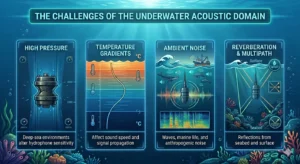
To provide a repeatable calibration environment, a system must account for:
→ High Pressure: Deep-sea environments alter the physical sensitivity of the hydrophone.
→ Temperature Gradients: Fluctuations affect sound speed and signal propagation.
→ Ambient Noise: Interference from waves, marine life, and human activity (anthropogenic noise).
→ Reverberation & Multipath: Unwanted reflections from the seabed and the water’s surface.
Inside a Hydrophone Calibration System
Digilogic’s approach to underwater calibration reflects a commitment to precision and mission-critical reliability. A professional-grade system consists of four essential pillars:
Acoustic Source (The Reference Signal)
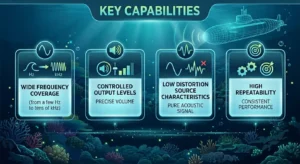
The core of the system is a stable underwater acoustic projector. It generates known Sound Pressure Levels (SPL) across a defined frequency range.
→ Wide frequency coverage: From a few Hz to tens of kHz.
→ Controlled output levels: Ensuring linear responses.
→ Low distortion: High-fidelity signal generation for repeatability.
Reference Hydrophone (The Gold Standard)
Every calibration requires a “trusted ear.” A standard reference hydrophone, certified by national metrology bodies, provides the baseline sensitivity. This ensures all measurements are traceable, consistent over time, and within allowable uncertainty levels.
Controlled Testing Environment
Calibration is typically performed in specialized settings to eliminate interference:
→ Free-field water tanks: For far-field acoustic conditions.
→ Pressure vessels: To simulate extreme deep-sea conditions.
→ Anechoic tanks: Lined with acoustic absorbers to reduce reflections and multipath errors.
Signal Conditioning & Measurement (The Digilogic Edge)
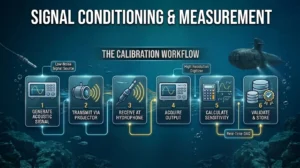
This is where precision engineering is vital. Digilogic integrates low-noise signal sources, high-resolution digitizers, and real-time data acquisition (DAQ) to measure the hydrophone’s voltage output.
Applications in Defence and Science
Hydrophone calibration supports a wide array of high-stakes missions:
→ Underwater Defence: Passive sonar arrays, submarine noise signature analysis, and intelligent surveillance.
→ Autonomous Systems: Acoustic navigation for AUVs and UUV-based tracking.
→ Oceanographic Research: Marine mammal monitoring and seismic studies.
→ OEM Manufacturing: Production-line testing and sensitivity matching for multi-element arrays.
The Digilogic Advantage: Traceability & Trust
In the world of defence and research, data is only as good as its traceability. Digilogic’s expertise in precision data acquisition and automated calibration infrastructure ensures that your systems are:
→ Accurate across wide dynamic ranges.
→ Repeatable across multiple testing sessions.
→ Robust under operational pressures.
→ Integrated with real-time analytics and certified reporting.
Conclusion:
Hydrophones are fundamental to how underwater platforms perceive the world, detecting threats, navigating safely, studying oceans, and supporting undersea defence networks. A Hydrophone Calibration System ensures that every one of these sensors, listens with accuracy, confidence, and consistency.
As underwater missions push deeper, operate quieter, and rely more heavily on acoustic intelligence, the demand for dependable calibration infrastructure will only intensify. With our expertise in precision data acquisition, underwater acoustics, and turnkey calibration environments, Digilogic Systems enables organisations to trust the signals they measure and to act on them with confidence. In deep sea waters, sound is the only certainty. A calibrated hydrophone ensures that certainty is accurate.