


In modern aerospace and defence programs, precision is no longer an abstract aspiration, it is a measurable, mission-defining requirement. As sensor payloads grow more capable and platforms operate in increasingly cluttered and contested environments, the ability to stabilise and point a sensor with microscopic accuracy becomes just as important as the sensor itself. This is where the Fire Control System (FCS) steps in: a quiet performer enabling extraordinary clarity in every mission profile.
Why Fire Control Systems Exist
Every electro-optical, infrared, or laser payload is only as good as its ability to stay locked on target. Platforms whether airborne, naval, or ground-based are constantly subject to vibration, wind loads, and micro-disturbances. Even tiny angular deviations can blur imagery, reduce ranging accuracy, or shift a laser spot meters off the intended point.
A Fire Control System addresses this challenge by acting as the final stabilisation and precision-pointing layer. While coarse gimbals bring the payload into the right region, the FCS ensures the last arc-seconds of accuracy, refining line-of-sight control until the target stays locked regardless of platform motion.
The Engineering Behind Fine Pointing
Digilogic Systems has long supported mission-critical systems that rely on speed, precision, and robust control. The engineering approach behind fine pointing aligns naturally with our expertise in real-time signal conditioning, motion control, and custom EO/IR test infrastructure.
A typical Fire Control System integrates four tightly linked elements:
Fast Steering Mirror (FSM): The Precision Engine
A Fast Steering Mirror is a lightweight mirror that moves extremely quickly to counteract disturbances. It delivers the final “fine correction” after the coarse gimbal, keeping the payload’s view steady even when the platform is not.
Key capabilities:
– Sub-microradian resolution
– High bandwidth (200-500 Hz)
– Voice-coil or piezo-driven actuation
– Rapid settling time
Inertial & Optical Sensing: The Awareness Layer
To stabilise anything, the system must first know exactly how it is moving. A Fire Control System relies on a blend of high-precision gyroscopes, micro-vibration accelerometers, optical detectors (quad-cell or focal-plane based), and encoders that provide exact mirror position feedback. These sensor streams form the real-time awareness needed for micro-level corrections.
High-Speed Control Algorithms: The Intelligence Layer
FCS controllers interpret sensor inputs and compute correction commands within microseconds, resulting in high-performance stabilization with minimal latency.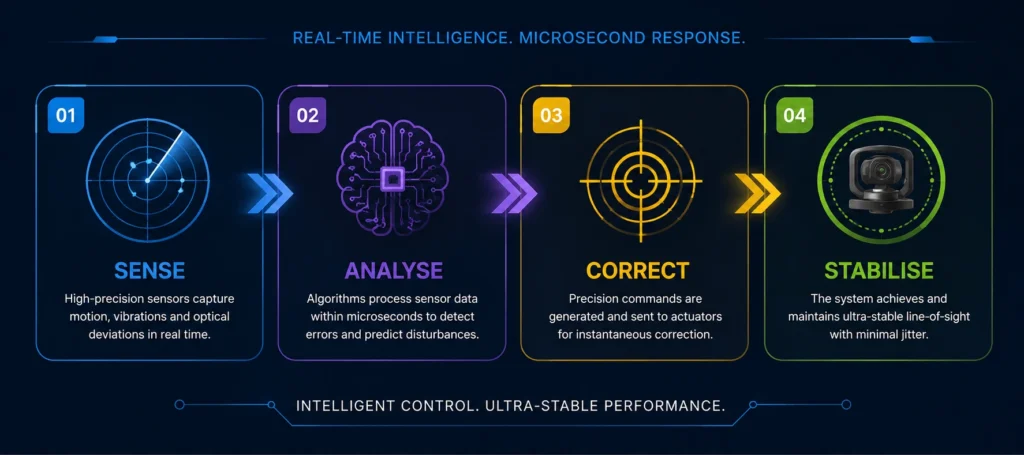
These algorithms include:
– State space control for rapid stabilization
– Feed forward vibration cancellation
– Adaptive filters for changing environments
– Line-of-sight (LOS) control loops
Mechanical & Thermal Stability: The Foundation
The structure that holds the mirror must be as precise as the mirror itself. This mechanical backbone ensures that the Fire Control System performs consistently in real-world conditions.
Structural features:
Lightweight, low-inertia mirror mounts
High-stiffness frames that prevent micro-flexing
Thermally stable materials (SiC, Zerodur, CFRP)
Isolation mounts that reduce platform-induced disturbances
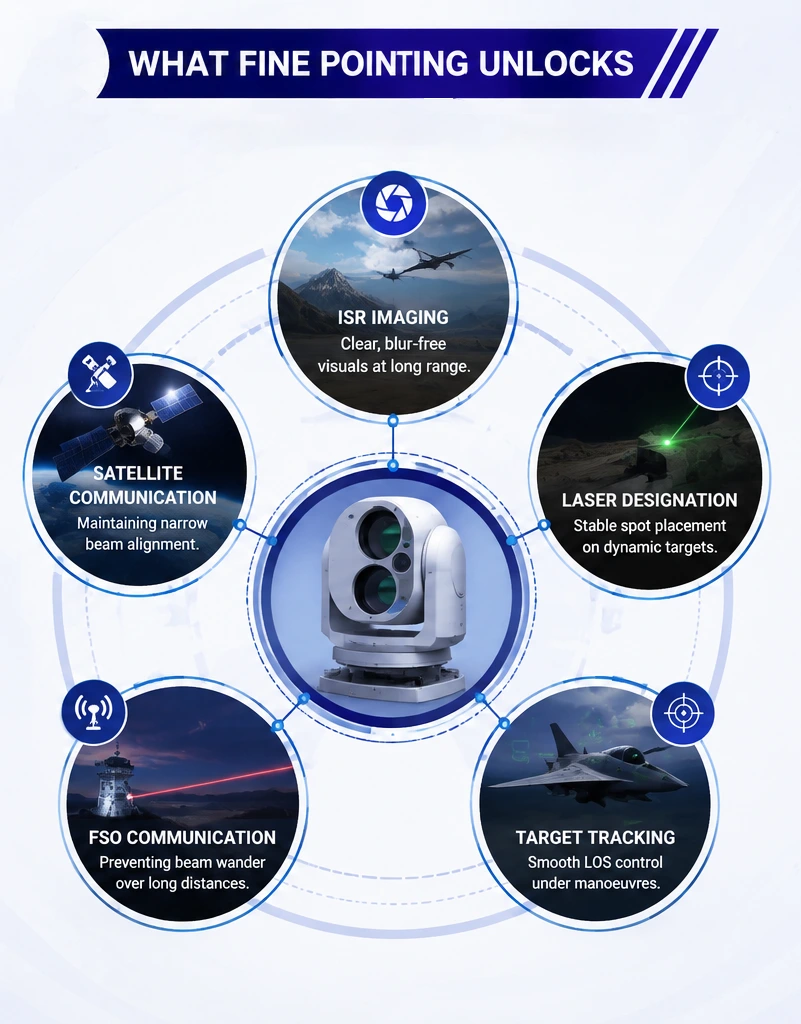
What Fine Pointing Unlocks
Testing & Validation: Where Digilogic Systems Adds Value
A Fire Control System requires meticulous validation. This process demands accurate motion simulation, optical metrology, high-speed acquisition, and dynamic analysis, exactly the categories where Digilogic brings decades of capability.

Digilogic’s custom-built benches, DAQ solutions, motion platforms, and optical test stations support the complete evaluation lifecycle from development and qualification to mission-readiness.
The Future of Fine Pointing at Digilogic Systems
These trends are aligned with Digilogic’s direction in precision motion systems, real-time embedded control, and EO testing:
Faster – bandwidths above 1 kHz for UAV turbulence profiles
Smarter – AI-assisted predictive stabilisation
Compact – MEMS-based fine pointing units
More integrated – hybrid optical-mechanical architectures
More responsive – FPGA-enhanced low-latency control
Conclusion
Fire Control Systems operate behind the scenes, but they are the force that brings modern defence technologies into sharp, reliable focus. By stabilizing sensors at microradian accuracy, Fire Control System technology ensures that platforms can see farther, track faster, communicate tighter, and engage with greater precision regardless of the environment they operate in.
From long-range ISR missions demanding crystal-clear imagery to laser designation that must remain locked on rapidly moving targets, to satellite and free-space optical communication links that depend on uncompromised beam alignment, Fire Control Systems form the precision backbone of today’s most advanced mission profiles. Their ability to counteract vibration, turbulence, shock, and thermal drift directly elevates the performance of every EO/IR and laser system they support.
As these applications expand across UAV surveillance, autonomous targeting, space-based communication, high-altitude platforms, and emerging electro-optical weapon systems, the demand for rigorous testing, validation, and high-fidelity performance will only grow.
With deep expertise in precision motion control, electro-optical validation, and real-time test infrastructure, Digilogic Systems stands uniquely positioned to support the design, qualification, and mission readiness of Fire Control Systems, ensuring they deliver accuracy where every microradian matters.